I have had so much fun this term learning about all the different people around the world, and the kinds of music that are a part of their cultures.
Something that I found surprising and relatively humbling was the earning per year differences between countries around the world. When Dr. Weeks showed us those differences, I felt my heart drop into my stomach. Even just envisioning that is something that is close to impossible for someone like myself – a privileged woman in college in the United States. It really puts life into perspective, and whenever I think about it, I realize that my stressors aren’t really all that important in the scheme of things. I want to use my career as a musician to help others, thereby (hopefully) bettering the world, at least in some small way. I want to keep others’ situations in perspective and always be kind, humble, and grateful. This class has really reinforced to me that this type of growth, along with respect for other cultures and people, is invaluable.
Something really interesting that I found out about my own personal music culture (having been raised partially on jazz) is that there are so many different types of jazz around the world, and many elements of that style which are used in other genres! It’s incredible to me that there can be so many sub-genres, and they just keep branching off and becoming more and more. It’s also nice to think about how different music genres can have so many of the same elements at the core.
This course really inspired me to learn more about traditional Arabic instruments as well as drums and bass, and inspired me to learn more about the Fulbright scholars program. About the instruments – I only really play one instrument (piano) and sing. Drums and bass are two very adaptable instruments to different styles in so many cultures, so I think they would be very useful to know how to play. I also want to go searching for a Qanun and learn over the course of my life how to play it. I think it’s a beautiful instrument, and I’d love to learn more about how it functions on a deep and interactive level. Concerning the Fulbright scholars program – again, I want to help people through music. It’s good for the soul, it’s good for the world. If I can formulate a project over the next year or so and figure out how to put that plan into action in a foreign country, I believe that would be an absolutely invaluable experience. Having seen firsthand and through others what goes on in the world, both good and bad, I believe that experiencing others’ cultures and bringing some of mine to them – no judgement, no superiority complex, no expectations – could allow me to be a part of something really, truly good.
Thank you, Dr. Vaneman, for your constantly positive and open spirit during this term – you’ve really made the class unforgettable!
Something that we looked at in class that was incredible to me was the Kecak men’s choruses that acted out scenes with their bodies. The passion with which they performed their acts was so intense and beautiful to me. With a little research, I read on a popular travel site about a nightly performance of a Fire Dance at the Uluwatu temple in Bali, Indonesia. The performance has an incredibly intricate plot about a woman stolen from her husband by a demon, and is open to the public. There is a moment when a monkey king sets fire to a “castle”, hence, the name “Fire Dance”. I was fortunate enough to find a video of the whole performance, and I have attached it below. Enjoy!
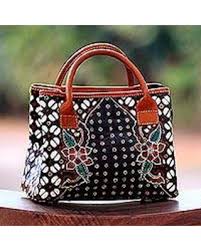
Indonesian culture fascinates me in general. I find the detail they put into almost every aspect of life beautiful, and that, of course, extends to their fashion and traditional dress. I visited a cultural website that detailed the traditional dress of Indonesian cultures. I found that in some cultures, traditional dress is reserved for royals and upper class families, but in others, traditional dress has been adapted for everyday use. One traditional type of clothing I learned about was the batik. The batik is a traditional cloth made using dyeing techniques, and looks different based on where it was made. Traditionally, the cloth was tied around the hips, but nowadays, it can be made into shirts, accessories, and more!
A batik design as a handbag.
Another design as a jacket.
Our talks in class inspired me to discover and talk about how cultural ideals span across many art forms and areas of life. Just as the Chinese have very specific ideas of what they find beautiful in music, they have specific ideas of what they find beautiful physically as well. As a person who finds makeup art to be an intricate and beautiful art if done well and has worked on skills in that area, I love finding different kinds of beauty trends from around the world. I’ve seen many “viral” makeup videos of Asian beauty trends, and found them all fascinating. The use of prosthetics and “transformation products” is a daily routine for some young women in China and Korea, and the “transformations” can be incredible and leave people looking unrecognizable. I attached one of the most viewed videos of a “transformation” below. Chinese beauty in physical appearance and beauty in music can be related, if one delves deeper. For example, the want of full lips can be translated to the want of a “fuller” sound in ensembles (with many kinds of instruments that all work together with heterophony).
This past Thursday evening, I called my dad on the phone to have our interview. When he answered, he had just gotten off work. We made some small talk about our respective days, and then he asked me what the deal was with this interview. I explained to him about our class blogs and topics, and what this one was for and about. I then checked that he was okay with me recording our chat, and after he said he was, I proceeded with the questions.
ME: Alright, so…What were some of the more popular music styles when you were growing up? Did you listen to what was popular or did you listen to stuff off the beaten path?
DAD: I actually listened to popular music; Cyndi Lauper, Madonna, Duran Duran, Men at Work…very 80s. Some of the later 70s stuff; a little bit of the later Carpenters stuff when I was younger, and I was real big into movie soundtracks. When Star Wars came out, it was big with me and I learned how to play that on the piano. That was a big thing because Star Wars was huge, E.T. was huge, Close Encounters of the Third Kind – all of that music by John Williams. Very popular for me. So, I would say pop music and movie soundtracks.
ME: That’s really cool! I know you mentioned some you listened to before, but who were some of your other favorite artists?
DAD: I was a big Men at Work fan. As a matter of fact, it comes on the radio station in Harrisonburg when I’m driving down there, and they play — they call it “easy listening”, I call it pop music when I was in high school — Men at Work and stuff like that. All of the stuff I listened to varied dramatically from what I actually performed, […] but what I listened to, like Xanadu – huge, loved that! Olivia Newton John – big fan of Olivia Newton John, still am. I wasn’t big into Cher, not a big thing. Wasn’t big into all the club-type music, but real popular… Duran Duran, Adam Ant – that was big…loved that. “It’s a Great Day for a White Wedding”…all that stuff. I used to love pop-type music like that. Most of which wasn’t from this country. Cyndi Lauper…all that.
ME: Oh, yeah. What was your favorite song as a kid, as a teen, in your college years, and even now?
DAD: When I was young, I didn’t listen to a whole lot of music laying around the house. When I was in high school, I was in dance choreography, so a lot of my music revolved around that kind of thing – stuff that you could do choreography to. Like a said, a lot of Adam Ant, Duran Duran, another one was the movie soundtrack to Top Gun, and 99 Luftballons, which I’m sure you’ve heard. Those were all songs that were immensely popular. I did choreography to a lot of it. So my favorite song when I was younger…I don’t know. I think “Like the Wolf”, you know, Duran Duran. Stuff like that. When I was younger, my tastes shifted dramatically. I started listening to a lot of Ella Fitzgerald, a lot of Cole Porter. I started really getting into the older music. When I was younger, like your age and my early twenties, I was a big fan of “A Nightingale Sang in Berkeley Square”, which is still one of my favorite songs. And Manhattan Transfer…a lot of that; “Coo Coo U” and “Java Jive”.
ME: I love “Java Jive”!
DAD: Yeah, a lot of that stuff when I was younger. And now, same stuff. I’ve gotten real big right now into listening to Sammy Davis Jr., which was not one of my favorites when I was younger. Not even ten years ago. So when I actually started to listen to a lot of the stuff that he did, despite the fact that he smoked three packs of cigarettes a day, he had a voice that was absolutely amazing, and his music is just awesome. So I’ve kinda been listening to a lot of Sammy Davis Jr. lately, and “Come Back to Me” is still just one of the most awesome songs, and Cherry Poppin’ Daddies did a cover of it, and it’s just really cool if you can look it up. It is the coolest rendition of the Sammy Davis Jr. song I’ve ever heard. So that’s kinda where I’m at right now. Lot of jazz. I hope that answered your question!
Side note: My dad and I share a love of the Rat Pack (Frank Sinatra, Sammy Davis Jr., and Dean Martin). That really sparked my love for jazz.
ME: Well, great! That was a great answer. So, you mentioned the choreography you did when you were younger. I knew about some of that, but I didn’t know that you did it to more popular songs. Did you ever do anything with that?
DAD: Well, when I was in high school, I started dancing with Disney. (Note: my dad lived in California.) I was simultaneously in dance choreography in high school, so a lot of the two kind of overlapped, and then I used that ability – the talents I learned at Disney, and the talents I learned in dance choreography – to then fuel my ability to be a one-man-band when it came to directing musicals. Which is a good and a bad thing, but that’s kind of what I do is take over everything, basically. So I used those talents to choreograph to a variety of different musical styles. I always called myself a really good “faker”, because although I learned the basics of tap, I always faked my way through it. Although I learned the basics of jazz, I always faked my way through it. *laughter* The music element is what carried me through that, because I’m still a believer – and I’ve said this my whole life – that music is the backdrop to everything. So, everything that I do: dance, life, driving the truck, whatever I’m doing, there’s always a soundtrack in my head. Music is constantly in the back of my head. And I would say half of it is just made up in my head. So, music played a big part in choreography, and I used it a lot.
ME: That’s awesome. Did you ever write down any of that music that went through your head?
DAD: Well, I took Composition and Music Theory in college, and I’m thoroughly convinced that only Calculus is harder. *laughter, a little more from me than him* Honest to God, I’m not a mathematician, and music is math. So you really have to be good at basic math, you know, fractions and all of that. So I never really got very skilled at writing music. You know, actually annotating it. I’m not good at that. Not well enough to do what’s in my head, that’s the problem. So when I wrote the musical The Silent Bells – which is published through Samuel French and actually has written music – I did the music, but it’s so basic because that’s all I’m able to do as far as notation. Then, when I wrote the music for Live From Station XMAS, which was written by your mom, I actually hired somebody to listen to my playing of it on the piano and annotate it. I can’t say that it was wholly accurate, but it was pretty close. I think if I was ever going to go back to school and take a class, it would be music theory, and I’d sit down and learn to notate the music in my head, which would be awesome.
ME: It’s a really useful skill. I think, having heard some of the stuff you’ve done – and I didn’t even know at the time that you wrote the music for Live From Station XMAS – having heard that, I think it’d be really great to see what you could do after taking a class on that. I’d love to see what you could do with the skills you have and the ones you’d gain.
DAD: I would love to, because like I said, John Williams was a big influence on me. I would say that his orchestrations and compositions — a lot of people write him off — but if you’ve ever heard his music, it’s awesome. I mean, the Star Wars soundtracks are just mind-blowing. [I] sit and listen to all of that music…and I have scores running through my head. It’s a talent not only to be able to notate, but to actually write orchestrations you have to be able to notate and know a lot of instruments. So it’s a bit more skill to do what I would really ultimately like to do than what I’m actually capable of doing. There are limitations. But, to actually sit down and write a piano score for something would be great, because you can always find somebody else to write strings.
ME: Of course, yeah! So, moving forward… What were some of the first purchases of music that you made and what was the format, do you still have it?
DAD: The very first LP that I bought was the disco version of Star Wars.
ME: *laughing* That’s so cool!
DAD: I don’t even know if you can find it now. Unfortunately, I didn’t take any of my records with me when your mom and I separated, but the first purchase that I made was the disco version of Star Wars: Hooked on Classics, which I was so into. If you’ve never heard of Hooked on Classics, it’s SO dated, but it’s disco versions of Mozart, Beethoven, Tchaikovsky, all of that.
ME: That is SO cool. I’m totally going to look that up.
DAD: So, that’s the first thing I bought, and then I bought Xanadu, which came out in 1980, and being the Olivia Newton John fan that I was, that was huge. Before that, the music that I got was stolen from your aunt. She had purchased the Star Wars soundtrack, and I had stolen that for a number of years. Chicago, Boston, those were other big groups that we had. A bunch of different stuff that I listened to on LP, but the format that you may or may not be familiar with is an 8-track. The other format that I had when I was probably 13 was 8-track, and — big surprise — all of it was Olivia Newton John. I mean, to this day, she’s probably as far as pop vocalists, one of my favorites. I just always liked her. I mean, she was never a blockbuster vocalist, and she never belted or did anything crazy. She was always pretty consistent with her music. I mean, “Let’s Get Physical” was probably the breakout song for her! Anyway, I’d say LP (vinyl) and 8-track. God, I’m old. *laughing*
ME: Now, I have to ask…what kind of music did you hate growing up?
DAD: When I was growing up, I never liked hard rock. AC-DC, Led Zeppelin, Black Sabbath — I couldn’t listen to it. I didn’t like it. My opinion was, it wasn’t music, because it didn’t do what music does in my head, and it’s done it all my life. It’s always there, it’s always in the background, and that was never, ever in the background. It’s like rap today. To me, rap music doesn’t follow my format of what I consider music that plays in the back of my head. It’s like whatever soundtrack is playing in my head…it’s like Gloria Estefan. I’ve never been a big Gloria Estefan fan, but her music is good and it plays in the back of my head every now and then, which is really weird. So, rap now – don’t get it, never liked it. Not my thing. Back then, it was what they called acid rock or hard rock. Never a fan.
ME: Huh…I didn’t know that.
DAD: I tried. I did. When I was in the military, a lot of the guys I was working with LOVED Black Sabbath and Led Zeppelin, and I tried to like it. It was kind of like, papaya. It just ain’t gonna happen. It doesn’t matter how many times I taste it, I’m never gonna like it.
ME: *laughing* It’s just like that sometimes with certain kinds of music, or even certain songs…
DAD: Yeah! I never bought an album for the album…I always bought an album for a song, because there was that one song on there I liked…Do you have any other questions?
ME: Yeah, probably too many…Did you –and this is something we’ve never actually talked about — did you go to any particularly interesting concerts when you were younger?
DAD: No. The very first concert I went to was to hear Al Stewart in England with your mom in 1990-ish.
ME: Oh, cool! Did you get to meet him?
Side note: Seeing Al Stewart live was also my first concert experience, though it was decades later.
DAD: No, I didn’t. But that was the very first concert I went to. I can honestly say that I don’t think I’ve been to any others. Other than yours, things at clubs, bars, stuff like that, but I’ve never actually paid for a ticket to go to a concert. Your stepfather is the complete opposite. He’s a huge Carrie Underwood fan. He’s seen Carrie Underwood, Reba McEntire…he’s done a lot of concerts.
ME: That’s great! I mean, that’s really cool. I didn’t know that. So, about travelling and stuff like you mentioned…when you were travelling with my mom, what were some of your favorite kinds of music from overseas?
DAD: I love Japanese orchestrations. Japanese and Chinese, if you’ve ever heard the Chinese National Orchestra, doing some very traditional Chinese music in Hong-Kong. I really love Asian music. I’m talking the kind of music that they use for dances and stuff. I love Irish music. Your mother got me into that. I’m a big Celtic fan. I love the Celtic Women, who’s a group who does that…I love that. So, that was a big influence in England and Ireland. And I love French – I guess it would be considered – cabaret-type music. I love that Moulin Rouge sort of stuff. As far as language goes, it’s by far my favorite language to listen to being sung.
ME: It’s a really beautiful language. I love singing in French.
DAD: The influence of Asia comes from seven years there. Didn’t get a lot of influence in Africa, I think we weren’t in that circle, but I’m sure there were. And in Belgium, there was a lot of French influence. And then English pop, what they called “drum and bass” – that’s what my album was based on. That’s what that whole venture was, the whole English “drum and bass” movement, where it’s very heavy bass, very heavy drums, and kind of lighter on every other element, like vocal and stuff like that – they were almost non-existent. So, when we did my album, the whole idea was to just change it up a bit. Change the drum and the bass element, but then add the traditional vocal melody line and add harmonies and stuff, which didn’t exist in that movement before. So that was a big thing in England.
ME: I had no idea about that influencing your album.
DAD: Oh, yeah. If you listen to it, it sounds very heavy drums – it almost sounds like a drumline.
ME: Yeah, it’s got the really quick beats in there.
DAD: So that’s drum and bass. My producer did that.
ME: That’s really cool…and that came out the year I was born or the year before?
DAD: It came out the year you were born. Wow…it’s that old. *laughing*
ME: *laughing* I gave one of the copies to Emma (my roommate).
DAD: Oh! Yeah, it’s an acquired taste. I’d like to go back in and change it up a bit. I don’t have the master tapes, though. That’s the problem. So I’d have to be able to split the recording apart…I don’t know. Production people know how to do that. Anyway, moving on.
Side note: I checked with my dad being okay with sharing his next answers publicly before moving on to the next questions, which require a little more explanation and slightly more personal answers, and he let me know he was perfectly fine with it. A brief, nonspecific explanation so this isn’t incredibly confusing: My mother and my father are divorced, and my dad is remarried to my stepdad, Don.
ME: Did you and any of your significant others have any special songs? I know about one of them, at least.
DAD: With your mom, our wedding song was “Somewhere Out There”. To this day, I can’t hear it. And – this is totally irrelevant but I have to cite this – despite what happened with your mom and I, I would not change anything as far as relationship, kids, all that. Because to me, the experiences that we had are valid and wonderful. So, that song kind of brings up a lot of emotions to me. And “I Choose You” brings up a whole lot of emotions with Don. I just get all emotional, and then…what’s the point? So, “Somewhere Out There” and “I Choose You”, as far as significant others go. There are other songs that have very strong emotions with me that are specifically related to me, but as far as significant others go, those are the ones. From a gay point of view with the reception and all of that, “I Choose You” was huge…I didn’t mention the B-52’s before, but they’re awesome and I’ve been listening to them for years, and we requested at the reception that they play pretty much everything that was B-52’s. So, that was big at the reception. As far as your mom and me go, “Suddenly Seymour”…We sang “Somewhere Out There” at our reception, so that was that. Moving on…
ME: Well, I know about the whole “Little Shop” thing…Anyway, here’s a good one…did you have any music that you listened to when your heart was broken?
DAD: Not really, because I’m a lot like my daughter. I tend to go into my head.
ME: *laughing* Way to call me out.
DAD: But really, when I’m sad or feeling emotional – “If I Loved You” (from the musical Carousel).
ME: Aw, what a good song…
DAD: If I want to feel worse, that’ll do it. *laughing* It’s not a sad song, it’s just a hypothetical song. You know, “If I loved you… this is the way it would be”. And ironically, they do love each other but they don’t know it. It’s not really the words…because when I’m sad or when I’m thinking too much, I gravitate to music without words. Except, in certain cases like “If I Loved You” and stuff like that, but I tend to gravitate towards stuff that allows me to think. That’s really what it is, because like you, I overthink. So that’s what I listen to, because when I hear people singing to me, I think about what they’re singing, and I’m not thinking about what I want to be. That was random, but…okay.
ME: No, I liked that! That was good. Now, I remember some of this, but not all of it because I was probably too young… Did you have any music you played to me or my brother when we were little?
DAD: You and I did stuff… Logan (my brother) not so much because he never gravitated to music with me, and I think that might be a disconnect between he and I. Logan was the computer guy, and it was me who introduced him to computer games, and it was me who taught him the computer stuff. Which, for a long time, I regretted, but now I’m very thankful for it, so there you go. But you were music. And it was all about whatever I could teach you. I remember Panama being probably the most vivid time where we would sit down and sing. And I never made you sing music that was “cutesy”. I wanted you to sing the stuff I liked. So you would sing music from “Carousel” and a lot of showtunes, and you did. “Somewhere Over the Rainbow” we recorded in Hawai’i, which seems like yesterday, but it was years ago.
ME: Yeah…I remember that!
DAD: I would just teach you whatever I could. I tried to teach you piano, and I think that’s when we realized that you really needed somebody dedicated to just doing that. My patience level as a teacher wasn’t the best. So, mostly I taught you a lot of showtunes. “Green Finch and Linnet Bird” was one of the toughest things that I taught you how to sing, and then you turned around and you’ve redone music that you did a long time ago. You kind of go back through the stuff we did back then. I sit down and I think about all the songs you and I did, but I’m sure they’re marked in a lot of books.
ME: Oh, yeah. There’s a whole Broadway book with Post-It notes all over it somewhere around.
DAD: And you did “Nothing” (from the musical “A Chorus Line”)…you auditioned for WLT for Kids with “Nothing” virtually. We recorded “Nothing” and I’ve still got that recorded…so, I mean, again, a lot of Broadway.
ME: I think [that recording] is on YouTube somewhere.
DAD: It is. And you singing “Silent Night” when you were a knee-high little grasshopper.
ME: I just saw that video on Facebook!
DAD: Yeah, I post that every year. You gotta remember: to know where you’re going, you’ve got to know where you came from. Because you can sit there and say “Oh, that wasn’t good,” or “Oh, listen to that technique thing,”, but really, how old were you? At that point, aside from me, you didn’t have any formal training. And you and I spent a lot of time singing. So, you did pretty well for someone who started with me. *laughing*
ME: Well, you were a good teacher!
DAD: I’m selfish when it comes to that. I want everybody to do what I want to do. I never would have chosen classical, it wasn’t my favorite. YOU did that. Your influence, your choice. And it was listening to things like “Batti, batti” (from Mozart’s “Don Giovanni”) and things like that, that then intrigued me to go on and find the opera or find the composer, and I’ve done that. And there are things that I’m like, “Wow…I never would have done that 25 years ago. That would never have happened.” So, I mean, it’s not just everybody else influencing you, you’ve been influencing yourself. Anyway…so that’s that. I don’t even knew what the question was orginally, but I hope I answered it.
ME: *laughing* You did, yeah! Now, I know you yourself played a lot of music in a lot of places, so…tell me about your experiences with that.
DAD: When I was in the Air Force, somebody found out that I had sung in high school, but I was originally in marching band. A cute girl came up to me and was like, “Todd, can you sing?” Because I guess the choral director was looking for guys. And I managed to switch from band to vocal ensemble, chamber singers, and all that good stuff by my sophomore year. So that kind of worked out like that. Then I graduated, and when I went into the Air Force, I hadn’t done a lot of music in maybe a year and a half other than playing the piano like I always do. I got into the Air Force, and somebody figured out I could sing. So for the four years I was active duty, I was the command performance vocalist for the national anthem. Nobody you know – and I’m not kidding – has ever sung the national anthem more than your father. I have probably sung the national anthem for military ceremonies equating to well over 300 times. Every officer graduation ceremony, every function, every game, everything. That’s how I wound up with so many letters of appreciation and how I got my stripe early, because all I did was sing for all of these functions. And they would feed me if it was a banquet. I’d get a meal. Then when your mom entered my life, she would come along as my guest, and she can tell you stories about that. We’d go to the NCO Club, we’d have dinner, and all I’d have to do was when it was time, get my butt up and go up and sing the national anthem. And THEN, somebody figured out I could play the piano. So then, for these functions, I sing the national anthem, and then during the period where they’re eating and talking, if it was a banquet, I’d play the piano. Then I did that all the way up to the time I got out of the Air Force, and then it happened when I was in the Guard. So when I went to Japan for the Air Force, that’s what I did – sing the national anthem. Then, when I met your mom and moved overseas, I didn’t do a whole lot musically other than theater when we were in England. Then we came back to Virginia, and it was theater, again, predominantly. Then, when we went back to England the second time, when you were born, I started a band with a Polish lady and a couple of instrumentalists, and we did Portuguese jazz. We played clubs all around England. Oh, I missed something – back in Africa. Right before Nica was born in 1993, I was also in a band called Midlife Crisis. I still have a painting of us. We played easy rock, Jimmy Buffett – I call it “old man music” – stuff like that. I played the piano and I sang occasionally, but mostly I just played piano. We performed a couple of places there, but it wasn’t until right before you were born in England that I really got into a band with music I really loved. Then we moved to Okinawa, and […] was looking for a partner to do the club scene in Okinawa – of which is big, by the way – and the restaurants, so I revisited Jimmy Buffett again, and did Smashmouth, stuff like that. So popular stuff, a little bit of jazz, and it was all a combination of pre-recorded instrumental stuff mixed with live guitar and piano and things like that. We did that for almost a year. That was right around the time you were about a year old-ish, I think. Logan was a little over a year, I think. So we did that until we lost the last gig that we had, and I don’t think we ever got another one. That’s music for you. Since then, I haven’t done a whole lot musically. I discovered a little bit in each country I was in, and I haven’t done a lot since. One of my dreams is probably to sing with the Tom Cunningham Orchestra. Before I die, if I could just do that one time, it would make my life. And do 1940’s songs like “Come Back to Me” – the music my dad taught me. Do some of the old world stuff. But since you guys were babies, I haven’t actually been in a band or done any gigging.
ME: Wow, I didn’t know a lot of that. I remember seeing the painting of Midlife Crisis in the basement a few times, though! It’d be really great to see you do some gigging again, maybe with some of the jazz stuff you do, or show tunes or something like that.
It was at this point that I thanked my dad for answering my many questions and showing me a lot more of his life with this interview. As if with perfect timing, my stepdad called on the other line for my dad. So, I thanked him again and we said our goodbyes for the night. I’m really grateful to have had the chance to talk with my dad about his many musical experiences, and I hope that you have found reading about them worthwhile as well.
Just as there is popular Arabic music that extends to many genres, the same goes for Indian music. One example of this is the Canadian YouTuber Lilly Singh, who is of Indian descent and makes hip-hop/pop music that is heavily influenced by traditional Indian music sounds. Her music has been in Bollywood films, including the women-empowerment song she is featured in below, “Mauj Ki Malharein”, which was in the movie Gulaab Gang.
Lilly Singh has done other collaborations as well, one of her most notable being with “Humble the Poet”. Their song below is called “IVIVI” — the Roman numerals for the area code for Toronto, the place the two call home. In the song, notice the use of Indian drums and sitar mixed with the hip-hop sound and Western production style. It really makes a unique sound!
When I was in my freshman year of high school, my concert choir performed a piece called “Balleilakka”, which had a music video we watched in class that I’ll never forget, which I’ve attached below.
Isn’t that fun? I didn’t think too much about where the video came from when I was younger, but now that we’ve taken a look at Indian music, I thought, “What better time could there be to revisit the topic?”
This video is from a Bollywood movie called Sivaji: The Boss. According to IMDb, the 2007 movie is about a software engineer that comes to India to serve and invest in the nation’s welfare. Some corrupt officials try to stop him, but he overcomes the obstacles. The movie became a success worldwide, and earned many awards. Sadly, I couldn’t find any info on how this song comes into play, but I did find a translation, which is below.
The Sun? The Moon? Who is he? Tell me now! Is he the medieval warrior? Tell me tell me Tell me now!
Look, look, who is he?
He is a pouncing wild cat’s legs
Tell, tell, who is he?
The Shiva who shoots down the bad guys
Eh A good route/way To Salem or Madurai? To Madras, Tiruchy or Thiruthani? Eh A good route For all the people When big brother comes to Tamil Nadu, it is America*
Can the river Kaveri and the hand split rice be forgotten? Oh, can the girls in Dhaavanis and expressive eyes be lost?
Our paddy thrashing contoured land
The dense forests
The roads which splash wet red soil
Run, run, run, run,
Run, run, run, run
(A game where people chase the others around)
The trees under which we play Sadugudu The glistening grass which covers the ground The dew drops which break as you touch them The hot idlis you get The railways that thunder The rapid gurgling of the Kaveri The folding white The fierce looking moustaches Stay in my heart
Stay in a village hut for some time
Through the holes in the thatched roof, try counting the stars
Switch off your cell-phone noises
We can listen to the insects’ pronunciations
We can walk barefoot, without our slippers
And talk to the soil as we go
Become children again…
We could braid the roots of the Banyan tree And adorn it with flowers In the outskirts, we can borrow a knife from a smith To sharpen our pencils
In the Anjara petti/box of spices Is the taste of Mother’s cooking The leaves crushed with a grinding stone With native chicken
The affection we have for our goats and cows
Will ask us to include them in the house food-portions (as allotted by a ration card)(?)
The care we have to give buttermilk to those who asked only for water
The smell of people (?)
Soil will fly here(?)
When the old lady makes medicines, Even ghosts will flee The affection with which we cook for our next-door neighbours lives here
Pretty neat. Something else that intrigued me was the types of Arabic dances. I thought it was so cute how the children in the video we watched in class knew the dance styles and were having fun doing the dances to the music. While there are hundreds of types of Arabic dances (one of the most popular being belly dancing), there are notable traditional dance styles from specific countries that. I’ve attached a video that shows examples from a few different countries, and includes Turkish, Arab, Persian, and Kurdish styles.
While watching the videos on didgeridoo playing and aboriginal dances in class, I became very intrigued with the body paint I noticed many of the aborigines wearing. So, I searched the web to find an explanation of what the paint might signify, how it is applied, what it is made of, and who may wear it, and I found a website called “Artlandish“, which is the website for an aboriginal art gallery located in Kununurra, Western Australia. I found out that the specific designs used by the aboriginals are indicative of their relationships to their family group, social class, tribe, ancestors, and more! I also found out that use of colors varies between tribes and regions of Australia, and that clay mixed with animal fat (for longevity, as ceremonies may last for days) is often used as a color source. Color pairing is also something that is used often (pink with red, yellow with white, etc.), and feathers, leaves, other parts of plants, shells, and even teeth and scars are used as arm and leg ornaments. I also found out that women are not allowed to paint themselves, and only specific relatives may paint them. The body paint and ornaments tell a story of the individual wearing them, and their ancestors.
Another thing I found fascinating was the concept of the Andean street musicians playing all over the world. This kind of transnational migration is really unique, and a very good thing for more than one reason. It allows the Ecuadorian people who travel to perform to develop many new relationships and make themselves a living, while allowing those who listen to the music to experience something new outside their own culture, and recognize and respect the differences of people and their music. I wanted to hear some of what they do as it’s happening in all the different places, so I looked for a few videos. Below, there is a video of an Andean group performing in Times Square Station in New York City. Enjoy!
The group Chaskinakuy, who were featured in our textbook, also really interested me. After listening to the selection “Amor Imposible” from the book, I couldn’t help but want to hear more and learn about their story. I looked up their official website and went to the Biography page to discover more about this unique group. An incredible thing about one of the members, Edmond Badoux, is that he is a master craftsman, and actually made many of the instruments that he and Francy Vidal used as a duo. He is respected as a craftsman for his making of the Andean kenas, sikus, antaras, rondadores, bombos, wankaras, and redoblantes. I was very eager to hear some of their music aside from that in the textbook, so when I found songs off the same album as “Amor Imposible”, I was excited to listen. I’ve attached a selection called “Andina” from their album, “Cosecha”, below. I hope you enjoy it as much as I did!
Having been in many different choirs since fourth grade, I’ve gotten the chance to see how people of different genders act in large ensemble situations. It was in high school when I really started to notice the differences between genders in choir. Something that I thought was really special was the dynamic between genders, specifically how our strengths and weaknesses helped each other grow and become better as an ensemble.
I noticed that while the sopranos and altos were very focused on technical aspects of the music, the tenors and basses were very focused on the emotion of the pieces and how to convey it. This really helped us get to a new level as an ensemble as we learned from each other. The sopranos and altos would help the tenors and basses stay focused when they were getting rowdy after having fun with the pieces, and the tenors and basses helped the sopranos and altos loosen up when we were getting bogged down with specifics and technicality. It was due to this and many other things that I am so grateful to have been a part of these choirs; it really was a special dynamic. During my time in high school, I was a part of both SATB and SSAA choirs, which included the advanced women’s choir, the treble choir (as a mentor), the concert choir, and the jazz choir. It’s hard to say because there were so many great pieces performed over the years, but I think my favorite songs to perform were done with jazz choir. We did everything from Broadway pieces arranged for a group to foreign pieces to pop songs and actual jazz standards.
My high school jazz choir doing a recording session at a local recording studio, Sono Luminus.
Jazz has been a big part of my life for some time, and something that I have noticed about it is that is a largely male-dominated genre. I do know of many women who enjoy jazz, but don’t necessarily perform it. I’m not sure what is holding women back, but I’d like to see more women be a part of performing jazz. Jazz is not “popular” music anymore and has not been for quite some time, but I think that if more women get involved in its performance, it could help bring back, re-popularize (and possibly modernize a bit to keep up with new music) what I believe to be a unique and beautiful genre of music.
I have long been fascinated in the roles of women in many different societies, and this certainly extends to Native American women. As we took a listen to the different songs in class, I noticed a heavy male presence and became interested in what more Native American women have done that flies under the radar. This lead me to discover a Smithsonian website entitled “In Our Own Voice: Songs of American Indian Women“. It talked about how most music by Native American women is done in private settings, as their role is traditionally more domestic. I learned about a specific song called the “Spotted Fawn Song”, which is a ceremonial and spiritual song basically about a girl’s first menses, when she becomes a woman. This is a unique and surprising topic (at least, to those used to the topics of most Western style music) that, upon further reading, I realized is a very appropriate one, as many Native American women’s songs are about renewal and new life. I’ve attached a short recording of the song below. As you can tell, it is very repetitive and accompanies a dance, which I could unfortunately not find a video of.
As anyone who read my first blog post is aware, my mother is very well traveled. Unsurprisingly, this led to her collecting many pieces from all around the world that are on display in our house in Virginia. One such piece is an Egyptian Doumbek drum. As we studied the different types of African drums in class, I thought of our Egyptian Doumbek and considered what kind of music might be played on it, as the sound is different than that of other African drums. The first video below is of a man names Fritz Heede playing a Doumbek. As you will hear, the sound is more hollow, bright, and sharp than that of say, the Agbekor. I also attached a video of an Agbekor Ensemble for comparison.
I was asked by my brother the other day if I had any SATB a capella arrangements I would be willing to send his way to have his choir perform. I said of course, and that I just had to take a quick look to edit some details on a few of them. As I was going through one of my arrangements, I noticed with a new eye that I had employed the use of some polyrhythms not in the original arrangement. I had done this to give it a fresh twist that had a different, but not unrecognizable, sound. I love the intricacy of polyrhythms, and while those I’ve written aren’t incredibly complex, those of many African songs are. Upon searching for examples of these, I found a video of a man from Nigeria and a man from Los Angeles collaborating to record a more modernized example of 1000-year-old African polyrhythms. Enjoy!
I wasn’t raised in a strictly religious household, nor do I consider myself to be a very religious person. However, it was an expectation from my extended family that we attend a Christian church at least occasionally. So, I became immersed in the music of the Episcopalian Church at a young age.
As is the norm in the Christian Church world, I experienced music that was used for celebrations of holidays in the Episcopalian Church, such as Easter or Christmas. I have also seen music used to teach young children about the stories in the Bible, or about the teachings of Jesus. There is also a large amount of hymn signing done by the congregation. This is used for worship on almost any given day in the Episcopalian church. Typically, what is found to be beautiful and meaningful in the Christian Church is Western styles of music – including choral, instrumental, and solo pieces. The styles can range anywhere from gospel music to a Handel piece. The music used in the particular church I attended evolved over time. Initially when I first came to the church, the music was all traditional Western Christian church music. There was nothing contemporary, because the music director at the time had her own ideas of what church music should be. However, she resigned, and after some time, another music director was found who was much more open to different styles.
Something that I noticed become a unique part of the specific Episcopalian Church I attend in Virginia is our use of story songs and original music. It is a small church where everyone knows each other, and we are all relatively close, so ideas and conversations about music and religion are freely and easily talked about. In the choir, we of course had arrangements of traditional songs that we performed in Ordinary time, but the Reverend made it clear that she would be open to hearing different kinds of music as well. My mother and I are both singer-songwriters, so we offered up religious music we had written. My mother wrote a few story songs for the Christmas season years ago, and she got to perform them this past year. My favorite religious song of hers is a sweet, lovely tune called “His Mother’s Eyes”. It tells the story of Mary looking at her baby Jesus for the first time, and speaks about how Mary may have felt at the time – experiencing both turmoil and joy. Unfortunately, there isn’t a recording of it, but I have attached the lyrics below. I hope you enjoy!
His mother’s eyes know the story, And in her eyes shine the glory. The little babe she sees a king will be, and the secret lies Deep within his mother’s eyes. Deep within his mother’s eyes. His mother’s arms know the sorrow, But for now there’s no tomorrow. On this quiet night she’ll hold him tight, protect him from all harms, Safe within his mother’s arms. Safe within his mother’s arms. His mother’s heart knows the worry, But for now there’s no hurry. What history holds time unfolds, and the mysteries start Deep within his mother’s heart. Deep within his mother’s heart.
I have been fortunate enough, even as young as I am, to have traveled a good amount with my family throughout my life. My mother’s work took her all over the world, and in the midst of her overseas career, my brother and myself were born. He was born in Brussels, Belgium, and I was born in Reading England, both of which we have visited since. I have personally lived in four countries – England, Japan, Panama, and the United States. In the U.S., I have lived in five states, including Virginia, West Virginia, Maryland, Hawai’i, and now, South Carolina. In addition to residing in different states and countries, I have visited many. In terms of states other than those I’ve lived in, I’ve visited Massachusetts, Tennessee, North Carolina, Georgia, Florida, Pennsylvania, New York, New Jersey, Michigan, Iowa, Arizona, California, and Washington. In terms of countries, I have visited Belgium, Denmark, Peru, and Mexico. In the United States and beyond, I have experienced many types of cultures and music which I do not consider my own, but I respect and appreciate greatly.
Within my little family bubble, I was raised on jazz music, as my grandfather on my dad’s side was a jazz singer, and my dad followed in his footsteps. Another large part of my self-identified musical culture is show tunes and the music of the 70’s through the early 2000’s. As I grew, traveled, met new people, and experienced more, I discovered more kinds of music that I grew to enjoy. I was fortunate enough to be a part choirs in the U.S. that exposed me to Indian songs, Gaelic music, South American tunes, and more! Through choir, I met people that widened my taste in music by exposing me to their personal musical cultures. I was introduced to heavy metal and hip-hop by two of my close friends, neither of which I had actively listened to before, but both of which I grew to appreciate.
Outside of the United States was where I discovered one of my favorite types of music outside of my own culture: the tamborito music of Panama. It is traditional folk-style music which utilizes drumming and call and response vocals. I remember as a kid, watching the men and women in their traditional dress (the montuno for men and the pollera for women) dance to the music. I had a friend who participated in celebration dances in her beautiful pollera. She had lived in Panama her whole life, and told me about the traditions of Panama and sometimes spoke to me and my brother in Spanish. I have attached an example of a dance in which tamborito is used, and the people are in traditional dress.
The memories of this music and the traditions surrounding it are some of my most vivid memories from childhood. I was reminded of it all over this past winter break, as I discovered dolls we had in our collection of trinkets from around the world; one of a man in a montuno and one of a woman in a white and blue pollera. I think I was a bit too young when I lived in Panama to appreciate it fully, but looking back now, I think of it all fondly and have great respect and appreciation for the music, the dancing, and all the traditions. I hope I can go back and visit someday.



 Nerys' Blog on Music of Diverse Cultures